
Community Empowerment in Disaster Mitigation Through Dissemination of Research Results in Salua Village, Kulawi District, Sigi Regency
DOI:
https://doi.org/10.55885/jucep.v6i1.832Keywords:
Disaster Mitigation, Research Dissemination, Local Knowledge, Community, Salua VillageAbstract
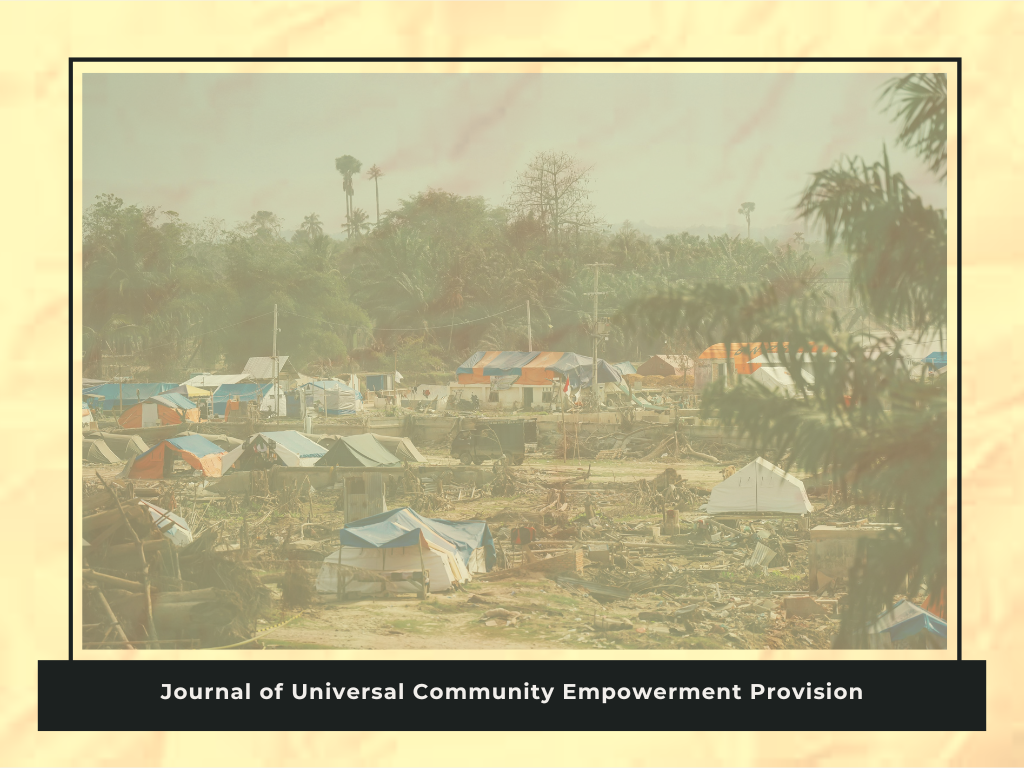
A dissemination program for research findings on settlement history, local knowledge, and disaster dynamics in Salua Village, Kulawi District, Sigi Regency, was implemented to strengthen community capacity in disaster mitigation efforts. This activity involved the village government, the Village Consultative Body (BPD), community leaders, women's leaders, and the Disaster Preparedness Group (KSB). Through dissemination and focused discussions (FGDs), findings emerged that village vulnerability is not only caused by ecological factors, but also by the weak role of formal institutions such as the Regional Disaster Management Agency (BPBD) and the forestry service in addressing forest destruction in upstream areas. Furthermore, the unclear function of the KSB also hampers the effectiveness of mitigation at the village level. Local community knowledge including migration history, settlement patterns, language, and experiences with floods and landslides serves as a crucial source of information in formulating community-based mitigation strategies. This program has yielded several outcomes, including increased risk awareness, the creation of participatory risk mapping, identification of the roles of local actors, and recommendations for strengthening village institutions through strengthening the Village-Based Village Council (KSB), implementing customary sanctions, and integrating local knowledge into village disaster documents.
References
Ali, T., Buergelt, P. T., Paton, D., Smith, J. A., Maypilama, E. L., Yuŋgirrŋa, D., ... & Gundjarranbuy, R. (2021). Facilitating sustainable disaster risk reduction in Indigenous communities: Reviving Indigenous worldviews, knowledge and practices through two-way partnering. International journal of environmental research and public health, 18(3), 855. https://doi.org/10.3390/ijerph18030855
Almekinders, C. J., Walsh, S., Jacobsen, K. S., Andrade-Piedra, J. L., McEwan, M. A., de Haan, S., ... & Staver, C. (2019). Why interventions in the seed systems of roots, tubers and bananas crops do not reach their full potential: Almekinders CJM et al. Food Security, 11(1), 23-42.
Ashahadu, S. H. (2018). Analysing the chieftaincy succession dispute in mandari and its socio-economic implications on the development of the Bole traditional area (Doctoral dissertation).
Bakti, I., Zubair, F., & Budiana, H. R. (2023). Participatory communication as the key to successful disaster management in Pangandaran district. Jurnal Kajian Komunikasi, 11(2), 195-214. https://doi.org/10.24198/jkk.v11i2.49785
Bang, H. N. (2024). Sustainable development goals, disaster risk management, and indigenous knowledge: a critical assessment of the interlinkages. Sustainable Earth Reviews, 7(1), 29. https://doi.org/10.1186/s42055-024-00101-x
Bhandari, P. B. (2013). Rural livelihood change? Household capital, community resources and livelihood transition. Journal of rural studies, 32, 126-136. https://doi.org/10.1016/j.jrurstud.2013.05.001
Bläse, R., Filser, M., Weise, J., Björck, A., & Puumalainen, K. (2025). Identifying institutional gaps: Implications for an early‐stage support framework for impact entrepreneurs. Corporate social responsibility and environmental management, 32(1), 679-697. https://doi.org/10.1002/csr.2939
Coates, T. (2015). Understanding local community construction through flooding: the ‘conscious community’and the possibilities for locally based communal action. Geo: Geography and Environment, 2(1), 55-68. https://doi.org/10.1002/geo2.6
Colten, C. E. (2006). Vulnerability and place: Flat land and uneven risk in New Orleans. American Anthropologist, 108(4), 731-734. https://doi.org/10.1525/aa.2006.108.4.731
Dasgupta, A., & Beard, V. A. (2007). Community driven development, collective action and elite capture in Indonesia. Development and change, 38(2), 229-249. https://doi.org/10.1111/j.1467-7660.2007.00410.x
Daskon, C. D. (2010). Cultural resilience—the roles of cultural traditions in sustaining rural livelihoods: a case study from rural Kandyan villages in Central Sri Lanka. Sustainability, 2(4), 1080-1100. https://doi.org/10.3390/su2041080
Datta, R. (2015). A relational theoretical framework and meanings of land, nature, and sustainability for research with Indigenous communities. Local Environment, 20(1), 102-113. https://doi.org/10.1080/13549839.2013.818957
Dorji, T., Rinchen, K., Morrison-Saunders, A., Blake, D., Banham, V., & Pelden, S. (2024). Understanding how Indigenous knowledge contributes to climate change adaptation and resilience: A systematic literature review. Environmental management, 74(6), 1101-1123. https://doi.org/10.1007/s00267-024-02032-x
Few, R. (2003). Flooding, vulnerability and coping strategies: local responses to a global threat. Progress in development studies, 3(1), 43-58. https://doi.org/10.1191/1464993403ps049ra
Fredericksen, P., & London, R. (2000). Disconnect in the hollow state: The pivotal role of organizational capacity in community‐based development organizations. Public Administration Review, 60(3), 230-239. https://doi.org/10.1111/0033-3352.00083
Gao, J., & Wu, B. (2017). Revitalizing traditional villages through rural tourism: A case study of Yuanjia Village, Shaanxi Province, China. Tourism management, 63, 223-233. https://doi.org/10.1016/j.tourman.2017.04.003
Glasson, G. E., Mhango, N., Phiri, A., & Lanier, M. (2010). Sustainability science education in Africa: Negotiating indigenous ways of living with nature in the third space. International Journal of Science Education, 32(1), 125-141. https://doi.org/10.1080/09500690902981269
Goodman, R. M. (2000). Bridging the gap in effective program implementation: From concept to application. Journal of Community Psychology, 28(3). https://doi.org/10.1002/(SICI)1520-6629(200005)28:3<309::AID-JCOP6>3.0.CO;2-O
Huang, S. M. (2018). Understanding disaster (in) justice: Spatializing the production of vulnerabilities of indigenous people in Taiwan. Environment and Planning E: Nature and Space, 1(3), 382-403. https://doi.org/10.1177/2514848618773748
Jha, A., Lamond, J., Bloch, R., Bhattacharya, N., Lopez, A., Papachristodoulou, N., ... & Barker, R. (2011). Five feet high and rising: cities and flooding in the 21st century. World Bank Policy Research Working Paper, (5648).
Johansson, J., & H. Keskitalo, E. C. (2014). Coordinating and implementing multiple systems for forest management: implications of the regulatory framework for sustainable forestry in Sweden. Journal of Natural Resources Policy Research, 6(2-3), 117-133. https://doi.org/10.1080/19390459.2014.913363
Kusumasari, B., & Alam, Q. (2012). Local wisdom‐based disaster recovery model in Indonesia. Disaster Prevention and Management: An International Journal, 21(3), 351-369. https://doi.org/10.1108/09653561211234525
Lawyer, C., An, L., & Goharian, E. (2023). A review of climate adaptation impacts and strategies in coastal communities: From agent-based modeling towards a system of systems approach. Water, 15(14), 2635. https://doi.org/10.3390/w15142635
Li, J., Wang, F., Wuzhati, S., & Wen, B. (2016). Urban or village residents? A case study of the spontaneous space transformation of the forced upstairs farmers' community in Beijing. Habitat International, 56, 136-146. https://doi.org/10.1016/j.habitatint.2016.04.009
Low, J. W., Ortiz, R., Vandamme, E., Andrade, M., Biazin, B., & Grüneberg, W. J. (2020). Nutrient-dense orange-fleshed sweetpotato: advances in drought-tolerance breeding and understanding of management practices for sustainable next-generation cropping systems in sub-Saharan Africa. Frontiers in Sustainable Food Systems, 4, 50. https://doi.org/10.3389/fsufs.2020.00050
Marsiglia, F. F., & Booth, J. M. (2015). Cultural adaptation of interventions in real practice settings. Research on social work practice, 25(4), 423-432. https://doi.org/10.1177/1049731514535989
Mehring, M., Seeberg-Elverfeldt, C., Koch, S., Barkmann, J., Schwarze, S., & Stoll-Kleemann, S. (2011). Local institutions: Regulation and valuation of forest use—Evidence from Central Sulawesi, Indonesia. Land use policy, 28(4), 736-747. https://doi.org/10.1016/j.landusepol.2011.01.001
Meijaard, E., Santika, T., Wilson, K. A., Budiharta, S., Kusworo, A., Law, E. A., ... & Struebig, M. J. (2021). Toward improved impact evaluation of community forest management in Indonesia. Conservation Science and Practice, 3(1), e189. https://doi.org/10.1111/csp2.189
Morrison, K. (2016). The role of traditional knowledge to frame understanding of migration as adaptation to the “slow disaster” of sea level rise in the South Pacific. In Identifying Emerging Issues in Disaster Risk Reduction, Migration, Climate Change and Sustainable Development: Shaping Debates and Policies (pp. 249-266). Cham: Springer International Publishing. https://doi.org/10.1007/978-3-319-33880-4_15
Mukarromah, L., & Pranoto, Z. L. (2024). Evaluasi implementasi desa tangguh bencana: Studi kasus di Jawa Tengah dan peran teknologi. Jurnal Ilmiah Wahana Pendidikan, 10(11), 370-382. https://doi.org/10.5281/zenodo.12698797
Nugroho, H. Y. S. H., Indrajaya, Y., Astana, S., Murniati, Suharti, S., Basuki, T. M., ... & Rahmila, Y. I. (2023). A chronicle of Indonesia’s forest management: a long step towards environmental sustainability and community welfare. Land, 12(6), 1238. https://doi.org/10.3390/land12061238
Nursanty, E., Rusmiatmoko, D., & Husni, M. F. D. (2023). From heritage to identity: The role of city authenticity in shaping local community identity and cultural preservation. Journal of Architecture and Human Experience, 1(2), 131-150. https://doi.org/10.59810/archimane.v1i2.17
Overdevest, C., & Zeitlin, J. (2018). Experimentalism in transnational forest governance: Implementing European Union forest law enforcement, governance and trade (FLEGT) voluntary partnership agreements in Indonesia and Ghana. Regulation & Governance, 12(1), 64-87. https://doi.org/10.1111/rego.12180
Qin, R. J., & Leung, H. H. (2021). Becoming a traditional village: Heritage protection and livelihood transformation of a Chinese village. Sustainability, 13(4), 2331. https://doi.org/10.3390/su13042331
Rahman, H. T., Saint Ville, A. S., Song, A. M., Po, J. Y., Berthet, E., Brammer, J. R., ... & Hickey, G. M. (2017). A framework for analyzing institutional gaps in natural resource governance. International Journal of the Commons, 11(2). https://doi.org/10.18352/ijc.758
Ramya, A., Poornima, R., Karthikeyan, G., Priyatharshini, S., Thanuja, K. G., & Dhevagi, P. (2023). Climate-induced and geophysical disasters and risk reduction management in mountains regions. In Climate change adaptation, risk management and sustainable practices in the Himalaya (pp. 361-405). Cham: Springer International Publishing. https://doi.org/10.1007/978-3-031-24659-3_16
Rayawan, J., Tipnis, V. S., & Pedraza-Martinez, A. J. (2021). On the connection between disaster mitigation and disaster preparedness: the case of Aceh province, Indonesia. Journal of Humanitarian Logistics and Supply Chain Management, 11(1), 135-154. https://doi.org/10.1108/JHLSCM-12-2019-0081
Sang Yum, M. K., & Baars, R. C. (2025). Reshaping disaster experiences: lessons from Samoan women’s disaster resilience. Disaster Prevention and Management: An International Journal, 34(3), 370-384. https://doi.org/10.1108/DPM-05-2024-0135
Seddiky, M. A., Giggins, H., & Gajendran, T. (2020). International principles of disaster risk reduction informing NGOs strategies for community based DRR mainstreaming: The Bangladesh context. International journal of disaster risk reduction, 48, 101580. https://doi.org/10.1016/j.ijdrr.2020.101580
Sirajuddin, Z. (2020). Local Wisdom as a Planning Strategy and Sustainable Settlement Development in ToKaili Traditional Settlement, Central Sulawesi, Indonesia. Rev. Eur. Stud., 12, 107.
Su, M. M., Wall, G., & Xu, K. (2016). Heritage tourism and livelihood sustainability of a resettled rural community: Mount Sanqingshan World Heritage Site, China. Journal of Sustainable Tourism, 24(5), 735-757. https://doi.org/10.1080/09669582.2015.1085868
Tajudeen, Y. A., Oladipo, H. J., Oladunjoye, I. O., Mustapha, M. O., Mustapha, S. T., Abdullahi, A. A., ... & El-Sherbini, M. S. (2022). Preventing the next pandemic through a planetary health approach: a focus on key drivers of zoonosis. Challenges, 13(2), 50. https://doi.org/10.3390/challe13020050
Tedesco, D., de Almeida Moreira, B. R., Júnior, M. R. B., Maeda, M., & da Silva, R. P. (2023). Sustainable management of sweet potatoes: A review on practices, strategies, and opportunities in nutrition-sensitive agriculture, energy security, and quality of life. Agricultural Systems, 210, 103693. https://doi.org/10.1016/j.agsy.2023.103693
Trinata, A., Dimas Ramadhan Perdana, S. H., Harahap, G., Fadillah, H. A., Marrino, J. R., Pamungkas, J. P., & Harahap, M. (2025). BENCANA EKOLOGIS Mereduksi Risiko, Memulihkan Indonesia. Yogyakarta: Samudra Biru.
Van Oudenhoven, F. J. W., Mijatović, D., & Eyzaguirre, P. B. (2011). Social‐ecological indicators of resilience in agrarian and natural landscapes. Management of Environmental Quality: An International Journal, 22(2), 154–173. https://doi.org/https://doi.org/10.1108/14777831111113356
Wagner, C., Cheung, K., Lee, F., & Ip, R. (2003). Enhancing e‐government in developing countries: managing knowledge through virtual communities. The Electronic Journal of Information Systems in Developing Countries, 14(1), 1-20. https://doi.org/10.1002/j.1681-4835.2003.tb00095.x
Downloads
Published
How to Cite
Issue
Section
License
Copyright (c) 2026 Journal of Universal Community Empowerment Provision

This work is licensed under a Creative Commons Attribution-ShareAlike 4.0 International License.